Can You Compost Indoors to Avoid Issues With Your HOA?
Listen to the Episode!
August 18, 2026

Joan in Cincinnati writes: I just moved from a large house with a double lot to a condo that has an enclosed patio. I used to create up to 5 gallons of compost a year but now have limited space. How can I compost in this space? PS: I am sorry to hear that you’re retiring, but after 30 years I understand.
Thanks Joan, but I only retired from the rigors of NPR. I’m still carrying the (weed burning) torch of safe and bountiful gardening, but at a much more relaxed pace, thanks to the fine folks at Gardens Alive/Gurney’s Seeds and Nursery, where new material and audio appears every week—hop on if you haven’t already. Visit the YBYG Facebook page for details and click throughs.
Back to Joan: is your new place an HOA?
“Yes, but we have an enclosed patio that they have little jurisdiction over. How well do the composters work where you dump waste on the top without tumbling? I’m used to spinning or tumbling the waste but the ones where you just drop stuff in from the top would be my first choice.”
Me: You don’t put new materials on top. You can just mix them in with a compost turner (a long metal tool that spins), pitchfork or other device, but I’m about to NOT advise doing that.
Now: the way I see it is you need either a small-scale tumbler—preferably on legs—or a sealed black ‘batch’ compost bin. I have several of the black recycled plastic ones out in my legendary compost corral and all they need is a good stirring once in a while to make great compost--IF you fill it correctly and observe the rules of “batch” composting. Filling it correctly means 80 to 90% of {quote} “dry brown carbon material”, which considering your limited space and their biological advantage, has to be shredded fall leaves. (Buy a handheld rechargeable leaf blower/vav now if you don’t already have one. Choose ones with the highest ‘mulching ratio’. For instance, a 10 to one ratio would reduce ten bags of whole leaves down to one bag—but a 14 to one would do the same for fourteen bags of whole leaves.)
Yes, I know that most composting books (except mine!) and even State Extension websites will list trash like junk mail, newspapers, sawdust and cardboard as compostable. And they will eventually look something like compost after a few years (maybe), but they have zero nutrition.
It is the shredded leaves alone that become compost; the small amount of wet green nitrogen rich material you mix into a correctly made pile simply feeds the organisms that help the leaves break down faster. And even though they’re not technically green, used coffee grounds are ideal for this; most kitchen waste is not.
I know that a lot of people take up {quote} “composting” in the hopes of recycling their kitchen waste, but sorry people—it just don’t work that way. Big piles of garbage will just turn into smaller, slimier and stinkier garbage. (Big plus for fans of wildlife: Every rat, mouse, raccoon and bear will flock to such a pile.)
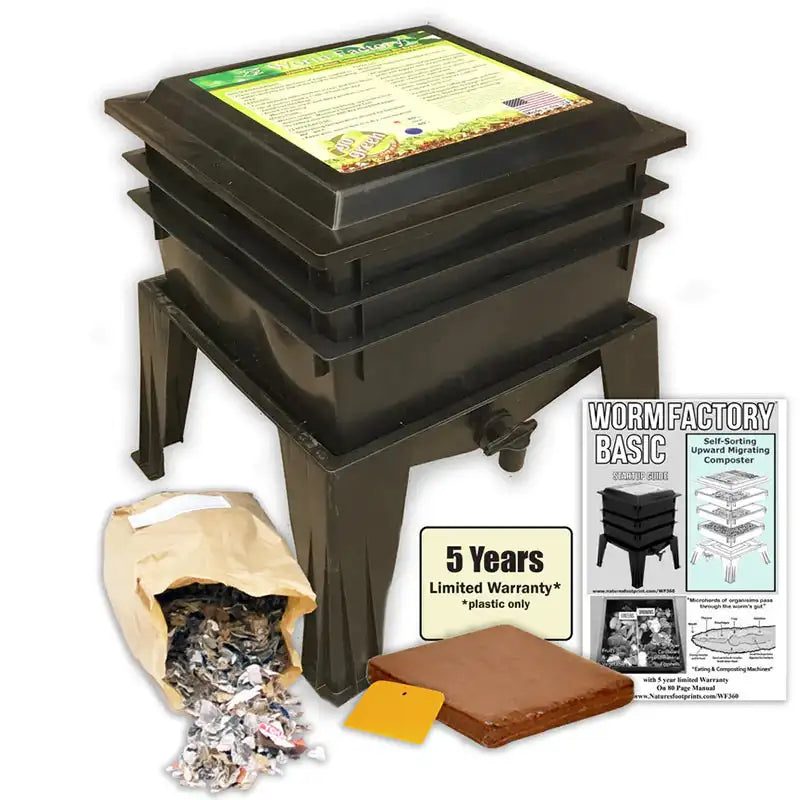
However, UNCOOKED kitchen waste like apple cores, outer lettuce leaves and produce that hung around past its time can be turned into super-premium worm castings by using a worm bin. I keep mine on our insulated porch (they have to be inside in regions where it freezes) and use the castings they produce as a mid-season pick me up (because I blow through all my outdoor compost by June).
I have—and highly recommend—a unit with stackable trays; you harvest the finished castings from the bottom tray and fill a new one on top with your fresh kitchen waste, shredded newspaper and some water. That’s it.
They stand about three or four feet tall (depending on the number of trays in use); and no, the worms don’t escape and there’s no odor if you fill the trays correctly. Pull off any identifying labels and nobody will know what the black box in the corner really is. And stackables come with a spigot at the bottom so you can harvest some worm tea for your houseplants and such pretty much on demand.
So, decide how much space you wish to dedicate and then review the dimensions of the composters. The stand-up ‘batch’ composters with lids that I’ve seen average about 24 or 26 inches wide and long and 31 or 32 inches high. They also range from holding about sixty to 80 gallons of material.
Spinners have the big disadvantage of holding only small amounts, but most are up on legs, a fine choice for those of us who have t-shirts that read “Bending is for chumps”. And you say that nobody from The Committee will bother with anything that’s indoors, so a spinner would be good for holding any ‘next round’ material while your main composter is cooking. Many different versions are available so measure your space twice and compare, compare, compare.
I presume your patio has a tile floor or something similar (no rugs!), so just have something around to put down underneath the batch composter (which is open at the bottom) to keep things tidy.
Big advantage: Whatever you choose will be indoors for the winter, a time when outdoor piles and bins slow down or shut down, so your compost should cook twice as fast—even faster if you shred the leaves twice before depositing.
And finally: ‘batch’ composting is when you fill a cage or a bin all the way to the top with shredded leaves in the fall, mixing in spent coffee grounds as you go (start saving them now. If you don’t drink coffee, ask the local coffee shop to save you a five-gallon bucket’s worth. It’s good for them as it reduces their waste disposal costs. But once it’s full, you leave a batch composter alone to compost down. In a heated room indoors, it will quickly reduce in size by half, and then half again by the Spring. Resist the temptation to top it off or you will upset the equation.
This is why we ‘back to the land’ people had outdoor bins with three compartments; the three-bin system. You piled raw material into the first section and let it cook down for awhile. Then you fork it over into the middle section and refill the first compartment with new stuff. Eventually you fork #2 over into #3, refill #1 with new material and then find something else to do until Spring, when you’ll harvest finished compost from #3 and start the process all over again.
New scraps go into the worm bin and cooked food and things like citrus and onions can be buried outside using a device known as the “Green Cone” As our Mantra Master Casey Stengel said, “You could look it up.”
I also asked you what went into your compost. You said: We mostly put food waste in: veggies, fruit, coffee grounds, etc. Also, paper and leaves.
Sorry, but that doesn’t make compost. The vast majority of a bin or pile MUST be composed of dry, carbon-rich browns—ideally shredded fall leaves. We know that this is not what the vast majority of you had hoped to hear; but the leaves MUST be shredded and the paper is worthless. To really be eco-friendly, mixed paper and cardboard should be recycled curbside, where the paper will actually become useful in its new form of tissues and toilet paper.
The more I think about it, you really just need a worm bin, not a composter.
Now: The big question we’re all thinking about: What are you going to do with all this compost in an HOA?? Do you have a cloaking device for your tomatoes???
Joan in Cincinnati’s reply: “What is a cloaking device for my tomatoes? And now that I have no squirrels, I can finally grow tomatoes, so I’ll take any suggestions and will share whatever compost is left with the gardening committee or simply return it to the earth; I hate the idea of wasting all that compostable material.”
Cloaking device: I meant, how are you going to get away with growing them outside in an HOA. For details on the device, please contact the Romulans—and don’t cross over into the neutral zone. Have them send it to you via UPS. You’ll probably need special currency.
Joan’s final comment is that she’s going to grow her tomatoes indoors. Good Luck!