Beat the Beetles!

(Yeah—I know I’ve used that headline in the past, but it’s too good not to use on this all-new 2026 article as well!)
Lawn owners: Do not treat your turf with anything now; the grubs that turn into emerging adults do not feed as they arise in the Spring, and they have to ingest the all-natural products that are effective against them in late summer/early Fall.
(Exception: beneficial nematodes, especially species that are labeled as exceptionally good for grub control. These miniature marvels don’t depend on the beetle ingesting anything; they ingest the beetle! They’re sold by the millions in surprisingly small pouches. Look for a good ‘sell by’ or ‘use by’ date, as they are ALIVE! ALIVE! (Insert voice of Colin Clive.)
(Note: you just drop the sponge containing the nematodes into CLEAN (not tap) water and then water the microscopic wigglers into your pre-saturated turf (water it well before application) just as the sun is setting. NOT in the morning or daytime.)
Right now, your other best course of action is to buy a single Japanese beetle pheromone trap and place it in the middle of the area where your plants are most often attacked. Do this in June. Check the trap daily, and when you see the very first beetle, drown the pest in soapy water, fold up the trap, seal it inside TWO Zip-Locks, and store it in the basement for re-use next year. This is called ‘monitoring’, and its only job is to tell you when the first beetles emerge, NOT to try and catch ‘em all.
(If you leave beetle traps up, they will attract four times as many beetles than usual, but capture less than half of them, increasing the potential danger to your plants.)
When you DO see that first beetle, begin spraying the plants they normally attack with a liquid solution of BTG, the newest strain of Bt (Bacillus Thuringiensis) in town. The original Bt was released around a hundred years ago (technically its name is BTK [for Kurstaki], but most people just call it Bt). Sprayed on plant leaves, it causes the gut of destructive caterpillars munching on that plant to immediately stop working and die. Widely available under a variety of brand names, old school farmers often just call it Dipel.
The next strain that was found to be useful was BTI (I for Israelensis, as it was discovered in Israel.) This strain of Bt only affects mosquitoes—specifically the eggs and larvae of mosquitoes that are developing in standing water. Add BTI dunks or granules to that water and they can’t finish the process and die before they can bite anybody. VERY effective.
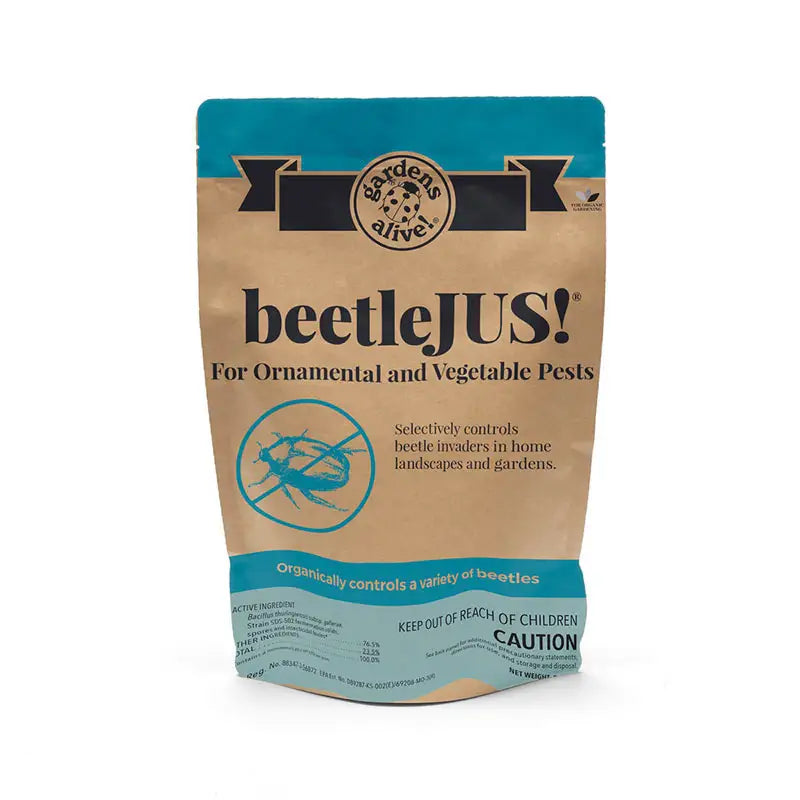
There are MANY strains of Bt constantly being tested and the latest winner is BTG (G for Galleria). It is an excellent organic control against beetle grubs AND adults, which is unusual and maybe unique. Originally (and still) sold by Gardens Alive as “Beetle-Jus” (yeah, yeah; I know; don’t say it out loud three times), it is slowly becoming available under more brand names. (And sadly, it wasn’t mentioned on any of the State Extension websites I checked; while some nasty chemicals were.)
Spray BTG on plants as soon as you capture or see the first beetle of the season and the beetles that follow will die soon after they eat the sprayed leaves. As with all such products, re-spray after rain.
And just so a couple thousand of you don’t call or email to ask if any of the Bt’s hurt children, pets, bees, birds, beneficial insects, and the like—the answer is NO!!! The original Bt only affects caterpillars that eat the leaves of sprayed plants—so don’t spray your parsley (host plant of a great butterfly.)
BTI only affects mosquito eggs and larvae breeding in standing water; nothing else. Your dog can drink it, your kids can play in it, birds and butterflies can drink from it.
And BTG only affects beetles in the scarab family, like Japanese, Asiatic, and June beetles/June bugs when they feed. OK? All of the Bts are super-safe! (And they are all based on naturally-occurring soil-dwelling organisms.)
When the adult beetles are done feeding for the season and disappear, it means the last females have laid their eggs in your lawn (or in some cases other plants; you can look it up).
At this time, you should apply nematodes, granular BTI or Milky Spore disease (another natural grub killer) to your turf. Grubs at this baby-to-teenage stage are ravenous and will ingest the BTI or Milky Spore granules as they fatten up on the roots of your lawn while preparing to survive the winter.
This is the ONLY time of year (late summer/early fall) to apply grub-killing materials to your turf, other than Nematodes, which, you will remember, eat the beetle grubs, spring and fall.
Other tips: Some species (especially the Asiatic beetle) are nocturnal and attracted to artificial lights, leading them to swarm around homes, porches, your roses and even enter buildings during summer nights. And they damage your plants unseen, just like slugs. If you see “Japanese beetle” damage on your plants but no beetles, spray the plants right before bedtime. (We’ll deal with slugs in a few weeks.)
Japanese beetles are also consumed by a variety of birds, beneficial insects, and small mammals, with starlings, robins, and cardinals acting as primary predators. Chickens love them and will gleefully eat them right off the plant. Or you can suck the beetles into a canister vacuum cleaner and open the bag in your chicken house. (The protein makes for better eggs!)
Other predators include spiders, assassin bugs (a VERY large family that includes the really cool-looking wheel bug), predatory stink bugs, and small mammals like shrews and moles, which eat the larvae (grubs). PS: If you see birds pecking at your lawn or racoon damage in late summer, break out the BTG!
And finally, I can’t resist sharing this “bug Juice” home remedy which I was reminded of while researching this article. It’s been popular since at least the 1980s: {quote} “This is gross but my neighbor told me to pick the beetles off by hand, mix them up in a secondhand blender with some water, strain out the big bits, put the rest in a spray bottle and spray your affected plants, reapplying when it rains. Haven’t done it myself but his landscaping looks a hell of a lot better than mine right now.”
Lawn owners: Do not treat your turf with anything now; the grubs that turn into emerging adults do not feed as they arise in the Spring, and they have to ingest the all-natural products that are effective against them in late summer/early Fall.
(Exception: beneficial nematodes, especially species that are labeled as exceptionally good for grub control. These miniature marvels don’t depend on the beetle ingesting anything; they ingest the beetle! They’re sold by the millions in surprisingly small pouches. Look for a good ‘sell by’ or ‘use by’ date, as they are ALIVE! ALIVE! (Insert voice of Colin Clive.)
(Note: you just drop the sponge containing the nematodes into CLEAN (not tap) water and then water the microscopic wigglers into your pre-saturated turf (water it well before application) just as the sun is setting. NOT in the morning or daytime.)
Right now, your other best course of action is to buy a single Japanese beetle pheromone trap and place it in the middle of the area where your plants are most often attacked. Do this in June. Check the trap daily, and when you see the very first beetle, drown the pest in soapy water, fold up the trap, seal it inside TWO Zip-Locks, and store it in the basement for re-use next year. This is called ‘monitoring’, and its only job is to tell you when the first beetles emerge, NOT to try and catch ‘em all.
(If you leave beetle traps up, they will attract four times as many beetles than usual, but capture less than half of them, increasing the potential danger to your plants.)
When you DO see that first beetle, begin spraying the plants they normally attack with a liquid solution of BTG, the newest strain of Bt (Bacillus Thuringiensis) in town. The original Bt was released around a hundred years ago (technically its name is BTK [for Kurstaki], but most people just call it Bt). Sprayed on plant leaves, it causes the gut of destructive caterpillars munching on that plant to immediately stop working and die. Widely available under a variety of brand names, old school farmers often just call it Dipel.
The next strain that was found to be useful was BTI (I for Israelensis, as it was discovered in Israel.) This strain of Bt only affects mosquitoes—specifically the eggs and larvae of mosquitoes that are developing in standing water. Add BTI dunks or granules to that water and they can’t finish the process and die before they can bite anybody. VERY effective.
There are MANY strains of Bt constantly being tested and the latest winner is BTG (G for Galleria). It is an excellent organic control against beetle grubs AND adults, which is unusual and maybe unique. Originally (and still) sold by Gardens Alive as “Beetle-Jus” (yeah, yeah; I know; don’t say it out loud three times), it is slowly becoming available under more brand names. (And sadly, it wasn’t mentioned on any of the State Extension websites I checked; while some nasty chemicals were.)
Spray BTG on plants as soon as you capture or see the first beetle of the season and the beetles that follow will die soon after they eat the sprayed leaves. As with all such products, re-spray after rain.
And just so a couple thousand of you don’t call or email to ask if any of the Bt’s hurt children, pets, bees, birds, beneficial insects, and the like—the answer is NO!!! The original Bt only affects caterpillars that eat the leaves of sprayed plants—so don’t spray your parsley (host plant of a great butterfly.)
BTI only affects mosquito eggs and larvae breeding in standing water; nothing else. Your dog can drink it, your kids can play in it, birds and butterflies can drink from it.
And BTG only affects beetles in the scarab family, like Japanese, Asiatic, and June beetles/June bugs when they feed. OK? All of the Bts are super-safe! (And they are all based on naturally-occurring soil-dwelling organisms.)
When the adult beetles are done feeding for the season and disappear, it means the last females have laid their eggs in your lawn (or in some cases other plants; you can look it up).
At this time, you should apply nematodes, granular BTI or Milky Spore disease (another natural grub killer) to your turf. Grubs at this baby-to-teenage stage are ravenous and will ingest the BTI or Milky Spore granules as they fatten up on the roots of your lawn while preparing to survive the winter.
This is the ONLY time of year (late summer/early fall) to apply grub-killing materials to your turf, other than Nematodes, which, you will remember, eat the beetle grubs, spring and fall.
Other tips: Some species (especially the Asiatic beetle) are nocturnal and attracted to artificial lights, leading them to swarm around homes, porches, your roses and even enter buildings during summer nights. And they damage your plants unseen, just like slugs. If you see “Japanese beetle” damage on your plants but no beetles, spray the plants right before bedtime. (We’ll deal with slugs in a few weeks.)
Japanese beetles are also consumed by a variety of birds, beneficial insects, and small mammals, with starlings, robins, and cardinals acting as primary predators. Chickens love them and will gleefully eat them right off the plant. Or you can suck the beetles into a canister vacuum cleaner and open the bag in your chicken house. (The protein makes for better eggs!)
Other predators include spiders, assassin bugs (a VERY large family that includes the really cool-looking wheel bug), predatory stink bugs, and small mammals like shrews and moles, which eat the larvae (grubs). PS: If you see birds pecking at your lawn or racoon damage in late summer, break out the BTG!
And finally, I can’t resist sharing this “bug Juice” home remedy which I was reminded of while researching this article. It’s been popular since at least the 1980s: {quote} “This is gross but my neighbor told me to pick the beetles off by hand, mix them up in a secondhand blender with some water, strain out the big bits, put the rest in a spray bottle and spray your affected plants, reapplying when it rains. Haven’t done it myself but his landscaping looks a hell of a lot better than mine right now.”